 Stoutmark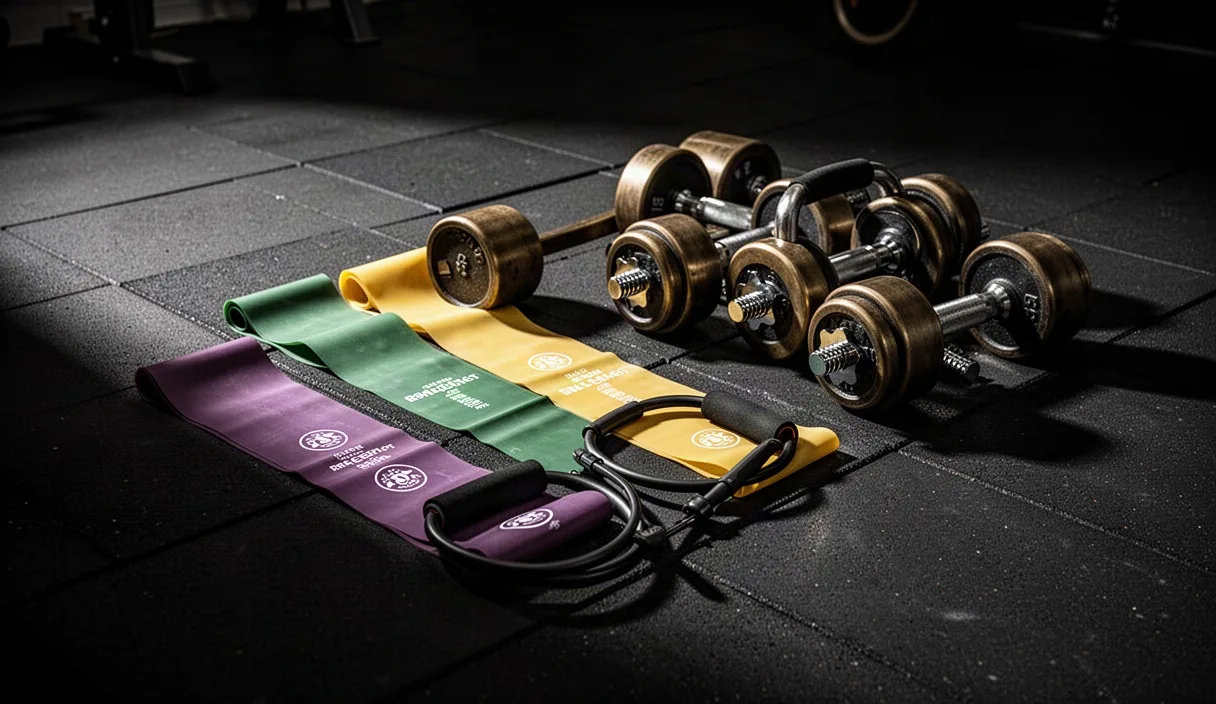

Walk into any gym and you will find two camps: the rack of iron plates and the wall of colored rubber bands. Both build muscle, both build strength, and both have loud advocates who insist their tool is superior. The truth is less tribal than the marketing. Resistance bands and free weights load your muscles through different mechanics, and those mechanical differences determine where each tool wins.
This article breaks down the physics, the research, and the practical trade-offs so you can decide what belongs in your routine, not what an influencer tells you to buy. We will look at strength curves, injury risk, portability, and how to combine both tools if you train at home with limited space.
How resistance differs between bands and weights
Free weights, whether dumbbells, barbells, or kettlebells, rely on gravity. The resistance stays constant throughout the range of motion, but your leverage changes. A bicep curl feels hardest around 90 degrees of elbow flexion, not because the weight changes, but because your muscle's mechanical advantage shifts. This is called a strength curve, and with free weights it is often bell-shaped: easy at the start, hard in the middle, easier again near the top.
Resistance bands work through elastic tension. The resistance increases as the band stretches, meaning the load is lightest at the start of the movement and heaviest at full extension. A band squat is easy at the bottom and brutal at the top, the opposite pattern of a barbell squat. This is called an ascending strength curve, and it matches how many muscles, especially in pressing and pulling movements, are naturally strongest at end range.
The practical result: bands and weights stress your muscles at different points in the same exercise. A push-up with a band around your back demands more from your triceps near lockout. A push-up with no added resistance demands more from your chest and shoulders at the bottom. Neither is "better," they simply target different portions of the same movement.
Quick comparison
| Factor | Resistance Bands | Free Weights |
|---|---|---|
| Resistance pattern | Increases through range of motion | Constant, but leverage changes |
| Peak load point | End of range | Mid-range typically |
| Load precision | Approximate, brand-dependent | Exact, printed on the plate |
| Portability | Fits in a bag, under 1 lb | Requires storage space |
| Cost for full range | $30 to $80 for a full set | $300+ for a home dumbbell set |
What the research says about strength gains
A frequently cited 2019 meta-analysis published in the Journal of Sports Science and Medicine compared resistance training with elastic bands against conventional weight training across multiple studies. The pooled results showed no statistically significant difference in strength gains between the two methods when volume and intensity were matched. Both groups improved 1RM equivalents and muscular strength markers by comparable margins over 8 to 12 week programs.
A separate study in the Journal of Strength and Conditioning Research tested trained lifters using band-only squats versus barbell squats over six weeks. The band group showed slightly greater improvements in the top half of the squat (the ascending phase), while the barbell group showed more balanced gains across the full range. Neither group's overall squat strength improved by a dramatically different amount.
What the research consistently shows is that progressive overload, not the tool, is the primary driver of strength. If you increase tension over time, whether by moving to a thicker band or adding plates, your body responds. Bands make progressive overload slightly harder to quantify because tension varies by brand and stretch percentage, while a weight plate always tells you exactly what you are lifting.
One caveat worth noting: most of these studies use trained or moderately trained adults over relatively short windows. Long-term data comparing years of band-only training against years of weight training is limited, so claims about which builds strength "faster" over a full year or more should be treated as reasonable inference rather than settled fact.
Where bands outperform free weights
Bands excel in situations where joint stress needs to be minimized. Because the resistance is lowest at the start of a movement, bands put less strain on a joint during the vulnerable initial phase. This matters for anyone recovering from a shoulder or knee injury, though anyone dealing with an actual injury should get clearance from a physical therapist or physician before loading it, band or otherwise.
Bands also outperform weights for accessory and activation work. Lateral band walks for glute activation, face pulls for rear delts, and pull-aparts for scapular stability are exercises where a light, consistent tension does the job better than trying to find a 2-pound dumbbell that does not exist. Many physical therapy clinics use bands almost exclusively for this reason.
Travel and space constraints favor bands decisively. A set of five bands covering resistance from 10 to 150 pounds weighs under two pounds combined and fits in a laptop bag. Replicating that resistance range in free weights would require a small home gym costing several hundred dollars and taking up a corner of a room.
Bands also allow variable resistance training that is difficult to replicate cheaply with weights. Attaching a band to a barbell (a technique called "banded" training) adds accommodating resistance, meaning the bar gets harder to move as you approach lockout, which some powerlifters use specifically to strengthen weak points in their bench press or deadlift.
Where free weights are still necessary
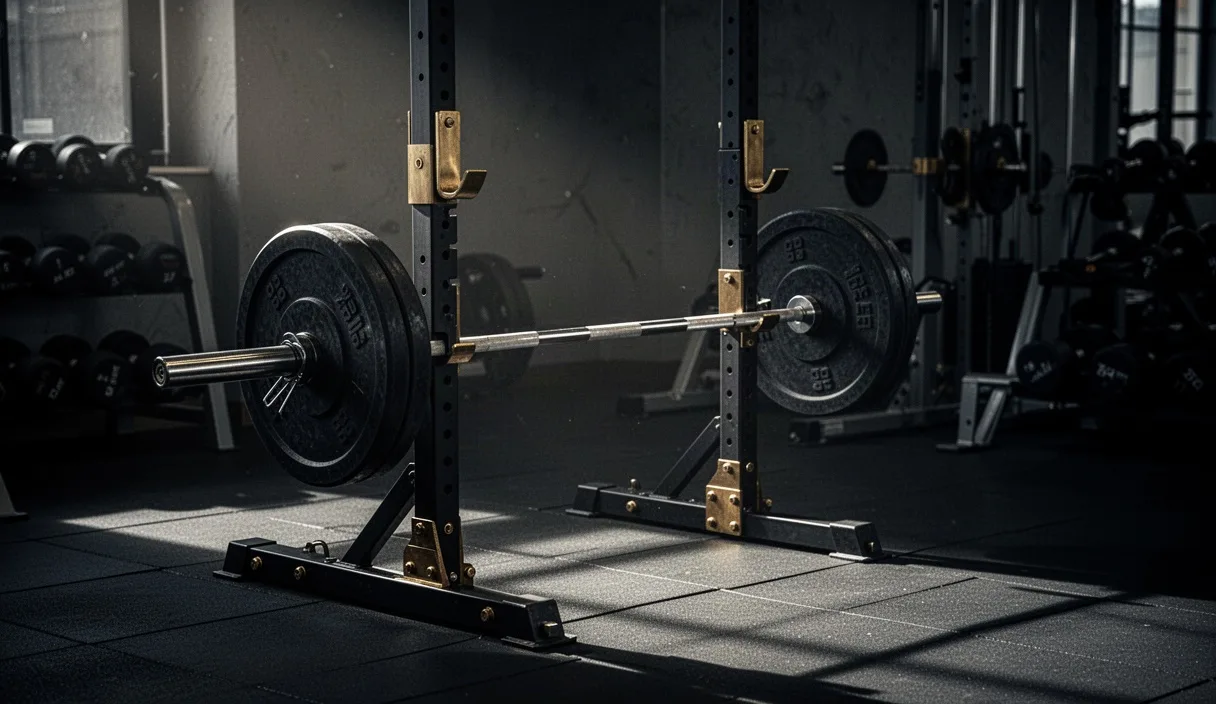
Free weights remain the standard for measuring absolute strength. If your goal includes knowing your one-rep max on a squat, bench, or deadlift, either for competition or personal benchmarking, you need a barbell and plates. Bands cannot give you a verifiable number the way a 225-pound bar can.
Free weights also train stabilizer muscles more directly because the load does not change direction based on stretch. A dumbbell held overhead challenges your shoulder stabilizers, core, and grip in ways a band, which pulls you back toward its anchor point rather than straight down, does not replicate. This is particularly relevant for anyone training for sports that involve unpredictable external forces, like wrestling or football.
For building maximal strength in compound lifts, most strength coaches still program free weights as the primary tool. A 2020 review in Sports Medicine noted that heavy free-weight training (above 80 percent of 1RM) produces the most reliable neural adaptations linked to maximal strength, and bands are difficult to load heavy enough to replicate that stimulus for large muscle groups like the quads and back.
Free weights are also non-negotiable for anyone tracking long-term progress with precision. A lifter who wants to know if they added five pounds to their bench over three months needs a fixed, known load. Band tension varies by manufacturer, by how worn the band is, and by exact stretch length, making it a poor tool for granular progress tracking.
Combining both for a home setup
Most home lifters do not need to choose one tool exclusively. A practical setup combines a moderate free weight collection with a full band set to cover both strength benchmarks and variable resistance work.
A reasonable starting home gym looks like this:
- One adjustable dumbbell set, 5 to 50 pounds per hand, roughly $250 to $350
- A set of five loop resistance bands, light through heavy, roughly $30 to $50
- One flat bench, roughly $100 to $150
- A door anchor or single squat rack for banded accessory work, roughly $40
Use free weights for your main compound lifts: squats, presses, rows, and deadlifts if you have a barbell. Use bands for warm-ups (band pull-aparts before pressing), for finishing accessory work (banded triceps pushdowns after a dumbbell bench session), and for any day your joints feel beat up but you still want to train volume.
A sample weekly split might run heavy dumbbell presses on Monday, banded pulling and mobility work on Tuesday, dumbbell lower body on Thursday, and a lighter band-only full body session on Saturday for recovery-friendly volume. This keeps joint stress cyclical rather than constant.
Choosing based on your goals and space
If your primary goal is measurable strength on standard lifts, free weights should be your foundation, with bands as a supplement for warm-ups and joint-friendly accessory work. If your primary constraint is space or budget, a quality band set can deliver comparable strength stimulus for most muscle groups, particularly for anyone training under an intermediate level.
Travel-heavy schedules favor bands almost by default. A five-band set covers a full-body routine anywhere with a door or a sturdy post, while free weights obviously do not fit in a suitcase.
Anyone recovering from injury or working around joint pain should default to bands for the early stages of rebuilding strength, and consult a physical therapist before reintroducing heavier free-weight loading. This is a case where professional guidance matters more than gym-forum opinions.
Common mistakes
Using the same band for every exercise is the most common error. A band that challenges your triceps will be far too easy for your glutes or quads, so a full set with varied tension is necessary, not optional.
Ignoring band wear is another. Rubber degrades with UV exposure and repeated stretching. A band that has lost elasticity gives you less resistance than it did new, silently reducing your training stimulus without you noticing.
On the free weight side, the most common mistake is chasing heavier loads before mastering the movement pattern, which increases injury risk without adding proportional strength benefit. Form should dictate load, not ego.
Next steps
Start by identifying your actual constraint: space, budget, joint health, or the need for measurable numbers. Buy a five-band set if you have none, they are cheap and versatile enough to justify the cost regardless of your primary tool. If you already own free weights, add bands specifically for warm-ups and any exercise that has started to bother a joint. Track your lifts numerically where possible, and if you are working around an injury or chronic joint issue, get a session or two with a physical therapist to build a program suited to your specific situation rather than relying on general advice.