 Stoutmark

Sleep hygiene is not a single habit, it is a set of small, repeatable decisions that either support your body's sleep drive or work against it. Most people who struggle with sleep are not dealing with a medical disorder, they are dealing with inconsistent timing, too much light at the wrong hours, or a bedroom that fights the body's natural temperature drop. Fixing these variables will not guarantee eight hours every night, but it removes the obstacles you control.
This checklist breaks the problem into six areas: wake timing, light exposure, temperature and setup, substance timing, wind-down habits, and a weekly review system. Each section gives you a specific action, not a vague suggestion. If sleep problems persist for more than a few weeks despite consistent changes, or if you suspect a condition like sleep apnea or restful sleep support disorder, talk to a physician or a sleep specialist rather than relying on self-management alone.
Setting a consistent wake time
The body's circadian clock responds more strongly to wake time than to bedtime. Waking up at the same hour every day, including weekends, stabilizes the release of daily balance in the morning and melatonin at night. A swing of more than 90 minutes between weekday and weekend wake times, sometimes called social jet lag, has been linked in research to worse mood and metabolic markers.
Pick a wake time you can hold for at least three weeks before judging results. If you currently wake at 6:30 a.m. on workdays and 9:30 a.m. on Saturdays, move the weekend wake time to within an hour of the weekday one, for example 7:30 a.m. This will feel difficult for the first five to seven days because your body is still running on the old pattern.
Use an alarm you cannot silence from bed if needed, but the long-term goal is to wake without one. That usually takes four to six weeks of consistent timing plus adequate light exposure, covered in the next section.
- Set one wake time for every day of the week, including days off.
- Avoid "banking" sleep by sleeping in more than one hour past your normal time.
- If you must shift your schedule, move wake time by no more than 30 minutes per day.
Managing light exposure in the evening
Light is the strongest external signal your brain uses to time melatonin release. Bright light in the evening, particularly the blue wavelengths common in phone and laptop screens, can delay melatonin onset by 30 to 90 minutes depending on intensity and duration of exposure. This is not a theory, it is measurable in saliva melatonin sampling used in sleep labs.
Start dimming household lights around two hours before your target bedtime. If your target bedtime is 10:30 p.m., switch overhead lights for lamps at 8:30 p.m. and keep brightness low. Reading on a phone or tablet at full brightness in bed is one of the most common self-sabotaging habits people report.
Get outside light exposure within an hour of waking, ideally 10 to 15 minutes without sunglasses. This anchors your circadian rhythm at the front end of the day and makes the evening wind-down more effective. On overcast days you need longer exposure, sometimes 20 to 30 minutes, since cloud cover reduces usable light intensity substantially.
| Light source | Effect on melatonin | Recommended timing |
|---|---|---|
| Outdoor daylight | Suppresses melatonin, resets clock | Within 60 minutes of waking |
| Overhead room lighting | Moderate suppression | Dim after sunset |
| Phone or tablet screen | Strong suppression at close range | Avoid within 60-90 minutes of bed |
| Warm lamp or candle | Minimal suppression | Safe for evening use |
Temperature and bedroom setup
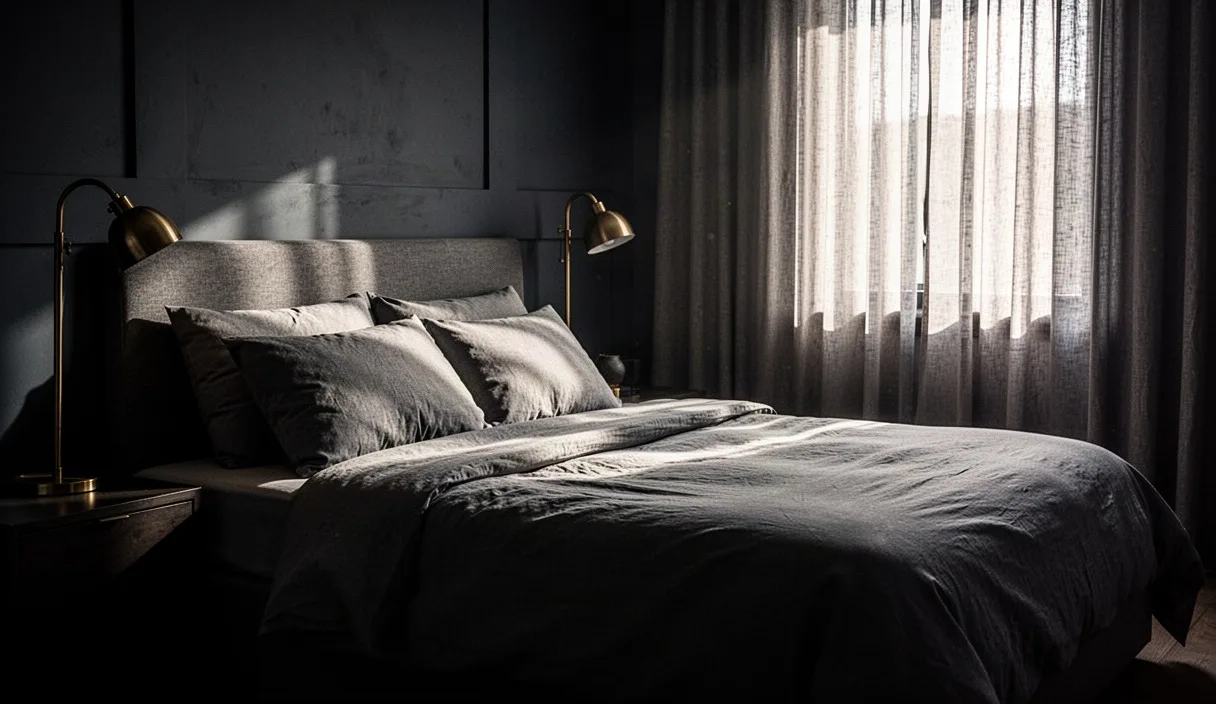
Core body temperature needs to drop by roughly 1 to 2 degrees Fahrenheit to initiate and maintain sleep. A bedroom that is too warm interferes with this drop directly. Most sleep researchers point to a range of 60 to 67 degrees Fahrenheit (15.5 to 19.5 degrees Celsius) as workable for most adults, though personal tolerance varies.
If you cannot control central heating, a fan, a lighter blanket, or a mattress topper designed for cooling can shift the room enough to matter. Taking a warm shower 60 to 90 minutes before bed can paradoxically help, because the body's rebound cooling after the shower accelerates the natural temperature drop.
Beyond temperature, reduce sources of unplanned light and noise. Blackout curtains, an eye mask, or simply turning device screens face-down handles light. For noise, a consistent low-level sound, like a fan or a white noise machine set around 50 decibels, masks irregular sounds such as traffic or a partner's movement better than silence does for many people.
- Set the thermostat between 60 and 67°F (15.5 to 19.5°C) if possible.
- Remove or cover light sources from electronics, including standby LEDs.
- Reserve the bed for sleep and intimacy only, not work or scrolling.
Caffeine and alcohol timing
Caffeine has a half-life of roughly five to six hours in most adults, meaning half the dose is still active in your system that long after consumption. A 300 mg cup of coffee at 3 p.m. still leaves about 150 mg in your bloodstream at 9 p.m., enough to delay sleep onset for many people. The commonly cited cutoff of "no caffeine after noon" is conservative but reasonable for anyone sensitive to it.
Alcohol works differently. It can shorten the time it takes to fall asleep, but it fragments sleep in the second half of the night by suppressing REM sleep and increasing arousals. People who drink within three hours of bedtime often report waking at 2 or 3 a.m. and struggling to fall back asleep, even if they do not remember it as restful sleep support the next morning.
A practical rule: stop caffeine intake eight to ten hours before your target bedtime, and stop alcohol intake at least three hours before bed, more if you had more than one or two drinks. Track this for two weeks alongside how you feel in the morning, since individual metabolism varies with age, liver function, and genetics.
Timing reference
- Coffee or energy drinks: last dose 8-10 hours before bedtime.
- Tea (black or green): moderate caffeine, same cutoff applies.
- Alcohol: last drink at least 3 hours before bedtime, longer for multiple drinks.
Building a wind-down routine
A wind-down routine works because it gives the brain a repeated, predictable signal that sleep is coming. This is behavioral conditioning, similar to how a specific song or smell can trigger a memory. The routine does not need to be elaborate, but it does need to be consistent and roughly 20 to 45 minutes long.
Start by listing activities that are calm but not sleep-inducing to the point of falling asleep on the couch, since that undermines the association between bed and sleep. Reading a physical book, light stretching, journaling, or a short breathing exercise are common choices. Avoid checking email or news in this window, both because of light exposure and because of cognitive stimulation.
One practical technique is the "worry list": write down anything on your mind for tomorrow on paper, then close the notebook. This offloads the mental rehearsal that often keeps people awake, without requiring you to solve the problem right then.
Keep the sequence identical night after night for at least two weeks before adjusting it. Consistency matters more than the specific content of the routine.
A ten-point checklist to review weekly
Use this list once a week, ideally on the same day, to check whether your habits are holding up. Mark each item yes or no rather than rating it, since vague self-assessment tends to drift over time.
- Did I wake within 30 minutes of my target time every day this week?
- Did I get outdoor light within an hour of waking on most days?
- Did I dim household lighting at least two hours before bed?
- Did I stop caffeine intake 8-10 hours before bedtime?
- Did I stop alcohol at least 3 hours before bedtime on drinking days?
- Was my bedroom temperature between 60 and 67°F (15.5-19.5°C)?
- Did I follow the same wind-down sequence each night?
- Did I keep screens out of bed for the last hour before sleep?
- Did I avoid naps longer than 30 minutes after 3 p.m.?
- Did I use the bed only for sleep and intimacy, not work?
If you answer "no" to three or more items in a given week, pick the single item that would be easiest to fix first rather than trying to correct everything at once. Sleep habits tend to stick better when changed one at a time.
Common mistakes
The most frequent mistake is trying to fix everything simultaneously: new wake time, new diet, new supplement, and a new mattress all in the same week. This makes it impossible to know which change is helping or hurting, and the overload often leads to abandoning all of it within ten days.
A second mistake is treating weekend sleep as recovery time rather than part of the weekly rhythm. Sleeping until noon on Saturday after a short week does not "repay" lost sleep in a simple way, and it pushes your circadian clock later, making Sunday night and Monday morning harder.
A third mistake is relying on alcohol or over-the-counter sleep aids as a long-term substitute for the habits above. Both can mask the problem short term while doing little to address the underlying timing or environment issues, and regular use of sleep medication should be discussed with a doctor rather than self-managed indefinitely.
Next steps
Pick one section from this checklist, the one that felt most relevant to your current habits, and commit to it for two full weeks before adding another. Wake time consistency is usually the highest-leverage starting point because it stabilizes everything else the circadian system depends on.
Keep a simple log, even just a few words each morning about how you slept and what you did differently, so you have real data instead of a vague impression after a month. If sleep quality does not improve after six to eight weeks of consistent changes across most of these ten checklist items, that is a reasonable point to consult a primary care physician or a sleep medicine specialist to rule out conditions such as restful sleep support disorder, restless leg syndrome, or sleep apnea.